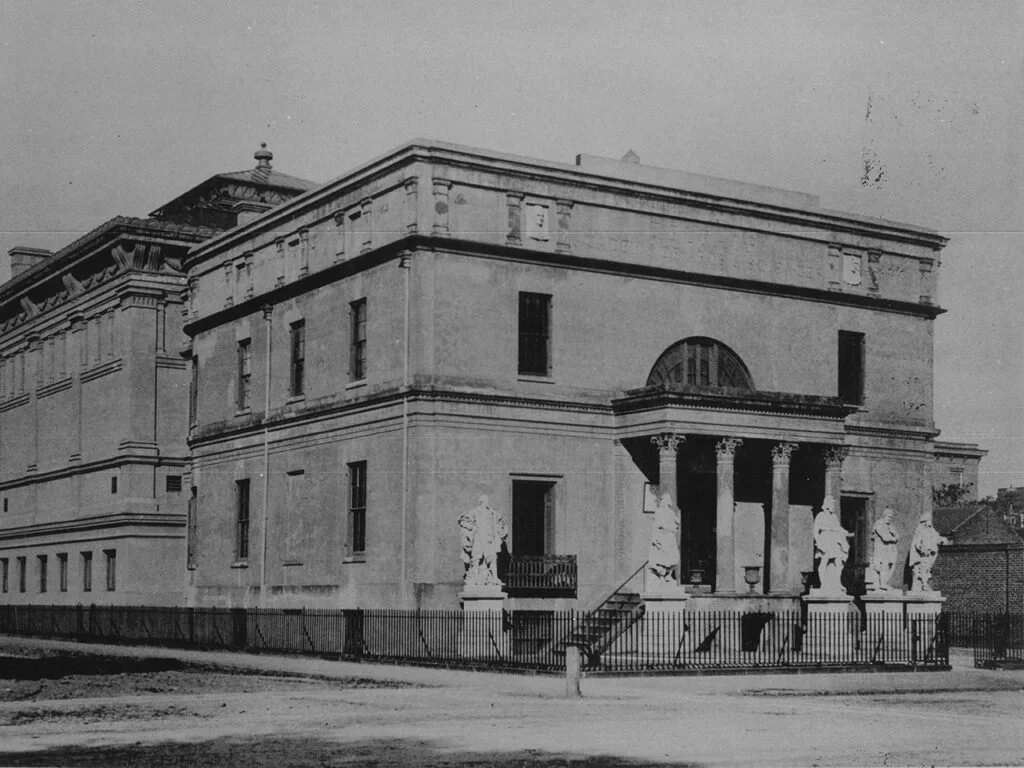
An Enduring Vision
Published in Savannah Magazine March/April 2026
As the Telfair Academy of Arts & Sciences turns 140 and the Jepson Center turns 20, we look back at the legacy of an institution that elevated the South onto the artistic world stage.
Written by ZACHARY LIVINGSTON
Photo courtesy of Telfair Museums
“As a home it is no more. Its halls are silent. But the public spirit which has devoted its time-honored walls to the noblest of all causes — the improvement of the public taste and the elevation of the public mind — has converted it into a perpetual monument of that love which the Telfairs entertained for their native city.”
These words — pulled from the May 3, 1886, edition of the Savannah Morning News — welcomed Savannah’s late 19th-century residents to the formal opening of the Southeast’s first public art museum: the Telfair Academy of Arts & Sciences. This institution, which celebrates its 140th anniversary this year, was originally envisioned as a glimmering display case that would bring the beauty of the international art world to the Hostess City.
Even so, it was clear from the beginning that, at its heart, the museum was to be a quintessentially Savannahian treasure. Now serving as the crown jewel of the Telfair Museums’ collection alongside the Owens-Thomas House & Slave Quarters and the Jepson Center, which opened its doors 20 years ago this March, the Telfair Academy tells a story of timeless elegance, historic change, and the balance between local identity and worldly ambition, much like the city it calls home.
A Legacy is Born
Before its debut as an art museum, Telfair Academy was the stately mansion of the Telfair family, whose patriarch, Edward Telfair, served as one of Georgia’s first post-independence governors. Edward’s son Alexander commissioned architect William Jay to design the neoclassical abode around 1818, but it was Edward’s eldest daughter, Mary, who transformed the home into the icon it is today.
Upon her death in 1875, Mary Telfair, a studious and sophisticated woman who’d become the sole heir to the Telfair’s vast fortune, bequeathed the family mansion, its collection of decorative and fine arts, and a large sum of money to the Georgia Historical Society, which she tasked with the creation of a grand museum. For roughly eight years, however, Mary’s will endured a string of litigious attacks from distant relatives, culminating in an 1883 Supreme Court decision upholding its bequests.
With the legal drama resolved, the Telfair’s board of trustees hit the ground running, hiring German-born artist Carl Brandt as the museum’s first director and sending him to tour the grand European salons with $20,000 and a mandate to acquire works to expand the museum’s collection. His procurement was immense — oil paintings, engravings, a litany of plaster casts — requiring the building of a significant addition to the mansion, which more than doubled its original size.
According to Elyse Gerstenecker, Telfair’s director of curatorial affairs and curator of decorative arts, by the time the museum opened in 1886, it had become “a great point of civic pride, a cultural institution that would match those in other cities.” Gerstenecker also notes that, while the museum was to be a boon for local residents, there was also a widespread understanding of the value such an institution would present for visitors to the city. “There was this anticipation of Savannah as a tourist destination even in 1886,” she says.
From there, the museum grew in influence and scale, offering a suite of arts education programs and a growing collection of world-class artworks, while expanding its footprint to include the Owens-Thomas House & Slave Quarters in 1951.
The New Kid on the Block
By the 1980s, however, the need for another major expansion became clear. “We needed better education space,” says Harry DeLorme, Telfair’s director of education and senior curator. “We didn’t have a proper loading dock. We didn’t have a freight elevator. There were exhibitions we just couldn’t get because we physically could not get the objects in the building.”
Preparations for the expansion began in the ’90s, and in 1998, the trustees chose the internationally renowned Moshe Safdie and Associates to design the new museum. Safdie, balancing the desire for a contemporary architectural landmark and the strict demands presented by Savannah’s Historic District, set to work creating what would become the Jepson Center for the Arts.
After a lengthy review process, Safdie’s final design was accepted in 2001, and over the next few years, residents witnessed the piecing together of an architectural masterwork — a bold, geometric marvel of glass, steel, and stone that emphasized openness and played with natural illumination and shadow. “It’s a building that’s constantly changing depending on the position of the sun and the weather,” DeLorme says. “It’s a very dynamic structure and one that worked pretty harmoniously with the historic environment.”
The Jepson Center opened in 2006, greatly expanding Telfair’s gallery, storage, and educational spaces. Over the last 20 years, it has served as Telfair Museums’ home for its contemporary exhibitions, bridging the gap between the institution’s historical roots and modern sensibilities.
Looking Forward to the Past
As Telfair Museums celebrates this year’s dual anniversaries, it’s also introducing two new offerings that aim to provide modern retrospectives on Savannah’s past. At the Telfair Academy, the Walter and Linda Evans Gallery of African American Art highlights works by African American artists from the late 19th century through around 1959, the year of the museum’s first ever exhibition of works by African American artists.
To accommodate the new permanent installation, the Academy’s period-accurate dining room was converted back into a gallery space, as it had been during the museum’s debut. The opening of the gallery also marks a significant development in the museum’s mission to look forward to a more inclusive future while acknowledging the darker elements of its past. To house such a historically vital collection of African American artwork in a museum whose dedication was attended by Jefferson Davis, the former president of the Confederacy, is no small testament to Savannah’s evolving ethos over the past 140 years.
Another historic offering of local significance is set to grace the Jepson Center this May with the opening of “Off the Coast of Paradise: Artists and Ossabaw Island, 1961–Now.” This new exhibition will focus on a pair of groundbreaking residency programs — the Ossabaw Island Project and Genesis — that brought artists and intellectuals to the enigmatic barrier island throughout the late 20th century. Although these initial residencies ended in the early 1980s, the island has continued to invite and inspire creatives over the last few decades through programs offered by the Ossabaw Island Foundation.
Since its inception as an artistic playground in 1961 under the tutelage of co-owner Eleanor “Sandy” Torrey West and her husband, Ossabaw has served as an inescapable muse for countless artists, musicians, and writers, its beautiful yet unquestionably wild vistas lingering with these creatives long after their departures. “For a lot of artists, it wasn’t just a one and done situation,” explains Erin Dunn, Telfair’s curator of modern and contemporary art. “It literally changed their trajectories.”
In addition to the exhibition’s paintings, sculptures, photographs, and other works, it will feature a newly commissioned film from visual artist Allison Janae Hamilton. The film, “Venus of Ossabaw,” will chart the protagonist’s escape from a plantation on the island, exploring powerful questions raised by Ossabaw’s long history. A cut of the film will be screened on the facade of the Jepson Center nightly for the first three months of the exhibition, a first for the museum.
With this new exhibition, Telfair Museums is drawing attention to a powerful yet underappreciated Southern artistic legacy, one that Dunn argues rivaled even the most famous 20th-century American artistic residencies. “A lot of times, the American Southeast gets overlooked in these broader narratives of art history,” she says. “We wanted to share the story and say that the South is really this hub of creative output that shaped a lot of careers and ideas — and I think Telfair is the perfect place to tell that.”